
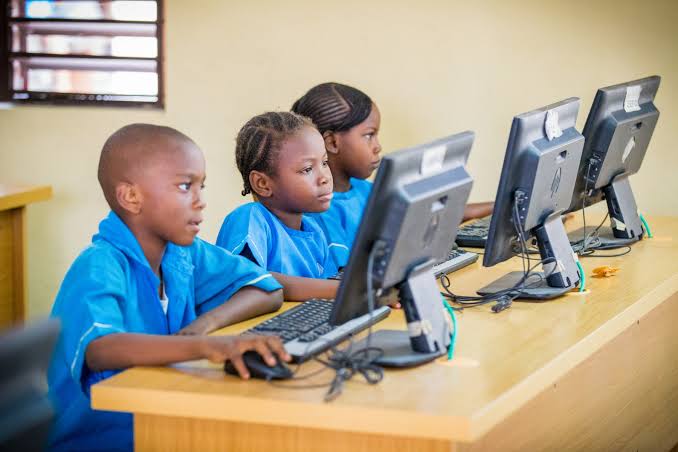

The Federal Government of Nigeria has formally unveiled a comprehensive new curriculum for both Junior Secondary School (JSS 1–3) and Senior Secondary School (SS 1–3), set to commence with the 2025/2026 academic session. The reform prioritizes digital literacy, entrepreneurship, and trade skills – marking a significant shift toward practical, globally aligned educational outcomes.
Key Curriculum Highlights:
Junior Secondary School (JSS 1–3):
Core Subjects: Students will engage with English Studies, Mathematics, Nigerian Languages (any one), Integrated Science, Physical and Health Education, Digital Technologies, Christian Religious Studies (for Christians), Islamic Studies (for Muslims), Nigerian History, Social and Citizenship Studies, Cultural and Creative Arts (CCA), Business Studies, and optionally French and Arabic.
Trade Subject: In a bid to enhance practical skill acquisition, each student must choose one trade-related subject from a selection that includes solar photovoltaic installation, fashion design and garment making, livestock farming, beauty and cosmetology, computer hardware and GSM repairs, and horticulture and crop production.
Subject Load: Students will take between 12 to 14 subjects in total.
Senior Secondary School (SS 1–3):
Compulsory Subjects: All students will take English Language, General Mathematics, Digital Technologies, Citizenship and Heritage Studies, and one Trade Subject.
Specialization Tracks:
Sciences: Optional subjects include Biology, Chemistry, Physics, Agriculture, Further Mathematics, Physical Education, Health Education, Foods & Nutrition, Geography, and Technical Drawing.
Humanities: Choices encompass Nigerian History, Government, CRS, IS, a Nigerian Language, French, Arabic, Visual Arts, Music, Literature in English, Home Management, Catering Craft, and more.
Business: Options include Accounting, Commerce, Marketing, and Economics.
Subject Load: Students will take 8 to 9 subjects, depending on their chosen specialization area.
Context & Rationale:
Announced at the 2025 International Conference of the African Curriculum Association, this curriculum aims to align Nigeria’s education system with 21st-century global standards, emphasizing competency-based learning, digital fluency, and outcomes-based education.
The integration of entrepreneurial and trade skills reflects a broader strategy to boost employability and equip students for a dynamic economy.
Official Commentary:
Education Minister Tunji Alausa, speaking via the Minister of State for Education Prof. Suwaiba Ahmad, described the reform as “future-ready,” highlighting its foundation in best practices, inclusive stakeholder engagement, and streamlined content for improved learnability and outcomes.
Implementation Preview:
Set to begin in September 2025, the curriculum mandates a careful rollout, with expectations that teacher training, resource allocation, and infrastructure upgrades will be vital for success.
Summary Table – Quick Snapshot
Level Total Subjects Key Components
JSS 1–3 12–14
Core academic subjects + one trade subject
SS 1–3 8–9 Core subjects + specialization (Science, Humanities, or Business) + one trade subject
This reform heralds a major shift toward practical, skills-driven education across Nigeria’s secondary schools.





Leave a Reply